Executive Summary
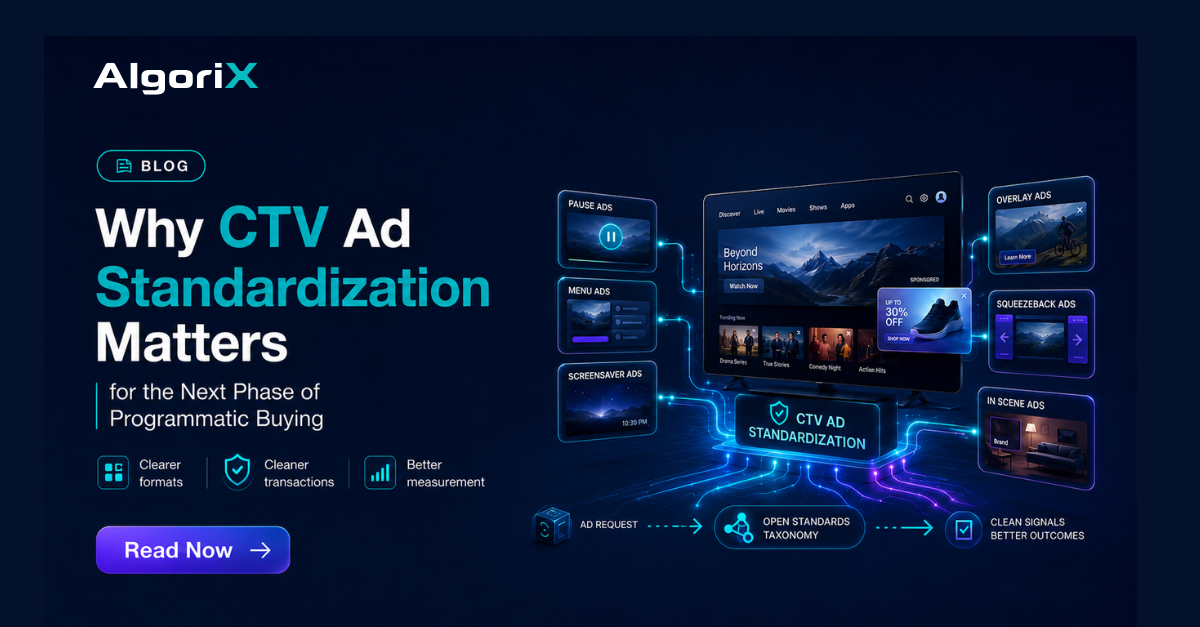
CTV has become one of the most important areas of digital video advertising, but the buying experience is still fragmented. As publishers, platforms, and streaming environments experiment with formats such as Pause Ads, Menu Ads, Screensaver Ads, Squeezebacks, Overlays, and In Scene placements, buyers need a clearer way to understand what they are buying.
That is why CTV ad standardization matters. Common format definitions can help buyers, publishers, SSPs, DSPs, and measurement partners describe emerging CTV experiences more consistently.
The timing is also relevant. IAB Tech Lab introduced standardized signals for emerging CTV formats in May, and the broader CTV Ad Portfolio guidelines are now in a second public comment period until July 16, 2026. Together, these efforts point to the same industry need: CTV needs a more consistent language for formats, signals, measurement, and programmatic transactions.
CTV is growing, but the format layer is still messy
CTV has moved from an experimental video channel into a core part of many media plans. According to IAB’s 2026 Digital Video Ad Spend & Strategy Report, U.S. digital video ad spend is projected to surpass $80 billion in 2026, with digital video accounting for more than 60% of total TV and video ad spend for the first time. As more budget moves into streaming environments, the pressure to make CTV easier to buy, sell, and measure is increasing.
The challenge is that CTV is not a single uniform environment. Inventory can differ across apps, devices, operating systems, publishers, streaming services, and ad products. A format that sounds similar across two platforms may behave differently in practice. Some formats are available through direct sales, some can be traded programmatically, and some still require custom execution.
That creates friction for everyone.
Buyers need to understand what the ad looks like, when it appears, whether it interrupts the viewing experience, how it is measured, and whether performance can be compared across partners. Publishers need to package and explain new formats clearly. Technology platforms need structured signals so buying systems know what kind of opportunity is being offered.
CTV does not lack innovation. What it still needs is consistency.
Why standardization matters now
The recent work around CTV ad standardization is not just a technical exercise. It is part of CTV’s maturation as a programmatic channel.
IAB Tech Lab’s CTV Ad Portfolio is designed to create a common framework for emerging CTV ad formats. The initiative defines format types and technical guidance so the industry can move away from one-off descriptions and toward more scalable buying and selling.
The current timing matters because this work is still active. IAB Tech Lab introduced standardized programmatic signals for the CTV Ad Portfolio in May, with a public comment period that ran through early June. Now, the broader Ad Format Guidelines for Digital Video and CTV are in a second public comment period until July 16, 2026 after revisions to technical specifications.
That makes the topic highly relevant now. The industry is still deciding how emerging CTV formats should be defined, signaled, and supported at scale.
Standardization does not make CTV less creative. It gives creativity a stronger commercial and technical foundation.
When formats are defined more clearly, buyers can compare opportunities more easily, creative teams can work from clearer specifications, publishers can package products more consistently, and programmatic systems can process CTV opportunities with less manual interpretation.
What formats are being standardized?
IAB Tech Lab’s December 2025 CTV Ad Portfolio announcement defined six core CTV ad formats based on more than 100 industry submissions:
Pause Ads
Ads that appear when a viewer pauses content.
Ads that appear when a viewer pauses content.
These can be less interruptive because they appear during a viewer-initiated break.
Menu Ads
Ads that appear within menu, home screen, or navigation environments before
Ads that appear within menu, home screen, or navigation environments before
the viewer selects content.
Screensaver Ads
Ads that appear when a device, app, or operating system enters an idle or
Ads that appear when a device, app, or operating system enters an idle or
screensaver state.
In Scene Ads
Ad placements integrated into the visual content environment or scene.
Ad placements integrated into the visual content environment or scene.
Squeezeback Ads
Ads that shift or resize content to create space for a branded message.
Ads that shift or resize content to create space for a branded message.
Overlay Ads
Ads displayed on top of content or the viewing interface without fully replacing the
Ads displayed on top of content or the viewing interface without fully replacing the
viewing experience.
These are not just new skins for traditional video ads. They appear in different
moments of the viewer journey. A Pause Ad is not the same experience as an Overlay.
A Menu Ad is not the same as a mid-roll. Each format carries different expectations around attention, interruption, interaction, measurement, and creative fit.
That is exactly why common definitions matter.
Why buyers should care
For buyers, CTV ad standardization can make planning less ambiguous.
If a media team is evaluating Pause Ads across several publishers, it needs to know whether those placements behave in comparable ways. When does the ad appear? How much of the screen does it occupy? Is there audio? Is it interactive? How long is it visible? Can it be measured consistently? Can the buyer control frequency?
Without shared definitions, every format becomes a custom explanation. That slows down planning and makes performance harder to compare.
With stronger standardization, buyers can focus less on decoding the placement and more on whether it fits the campaign objective.
A brand campaign may value a high-impact format that appears during a natural break in viewing. A performance campaign may care more about measurable interaction, QR engagement, or incremental reach. A premium video campaign may prioritize non-disruptive placements that preserve the viewing experience.
The more consistently these formats are defined, the easier it becomes to match format choice with strategy.
Why publishers and platforms should care
Standardization is also useful for publishers and platforms. CTV publishers are under pressure to grow monetization without weakening the viewer experience. Emerging ad formats can help create new inventory moments beyond traditional pre-roll and mid-roll, but they are harder to scale if every product needs custom explanation, custom creative, and custom measurement.
A shared format language helps turn innovation into repeatable products.
It can make premium CTV inventory easier to package. It can reduce buyer confusion. It can support programmatic demand. It can also help publishers protect the viewing experience by setting clearer expectations around how formats appear and behave.
This is especially important because not every large-screen ad experience is automatically premium. Premium depends on the quality of the environment, the strength of the placement, the relevance of the creative, and the way the ad fits into the viewer’s session.
Standardization gives the market a better foundation for evaluating those factors.
The programmatic angle: formats need to be machine-readable
The most important part of CTV ad standardization may be what happens behind the scenes. For programmatic CTV to scale, formats need to be understandable not only to humans, but also to buying systems. A DSP needs to know what kind of ad opportunity is being offered. An SSP needs to describe that opportunity consistently. Buyers need controls around format, context, measurement, suitability, and frequency.
That is why IAB Tech Lab’s standardized signals proposal is important. The May announcement focused on how emerging CTV formats, including Pause and Menu Ads, can be communicated programmatically with greater clarity and efficiency.
This moves CTV closer to a market where emerging formats can be traded more consistently, rather than handled as custom executions each time.
The same logic applies to broader supply-path optimization. Buyers do not only need access to inventory. They need to understand the quality, structure, and accountability of the path through which that inventory is bought. In CTV, format clarity is becoming part of that supply-path conversation.
If the format is unclear, the buying decision is unclear.
Standardization should support a better viewer experience
CTV advertising is different from many digital environments because it is usually viewed on a large screen, often in a lean-back setting. Poorly executed formats can become intrusive quickly.
That is why standardization should not only serve buyers and platforms. It should also help protect the viewer experience.
Clearer format definitions can help set expectations around:
-
when the ad appears
-
how much screen space it uses
-
whether content is interrupted
-
whether sound is included
-
whether the viewer can interact or dismiss the ad
-
how frequently the format appears
-
how the placement affects the content experience
This matters because CTV’s value depends on attention and trust. If new formats feel confusing, inconsistent, or too aggressive, they may weaken the premium environment that advertisers want in the first place.
A format becomes valuable when the placement, context, creative, and user experience work together.
Measurement still needs to catch up
Standardized formats can also support better measurement. CTV buyers increasingly want more than reach. They want to understand exposure, attention, interaction, brand lift, incremental reach, and business outcomes. But those comparisons are harder when formats are not defined consistently.
Before advertisers can compare performance, they need confidence that they are comparing similar experiences.
Format standardization does not solve every CTV measurement challenge. The channel still faces fragmentation across platforms, devices, identifiers, apps, and outcome signals. But common format definitions can make measurement cleaner by reducing one layer of ambiguity.
Verification also remains important. IAB Tech Lab’s Open Measurement SDK supports third-party viewability and verification measurement across web video, mobile app, and CTV environments. More recently, IAB Tech Lab added Device Attestation support in OM SDK to help combat device spoofing and provide stronger signals that CTV and mobile inventory is being delivered on genuine devices.
For buyers, this reinforces a larger point: CTV quality is not only about the format. It is also about whether the impression is legitimate, measurable, and delivered in a trusted environment.
That aligns with the broader movement from black box to glass box in digital advertising. As CTV becomes more programmatic, transparency around formats, devices, supply paths, and measurement will become harder to treat as optional.
What buyers should ask before buying emerging CTV formats
As CTV formats become more sophisticated, advertisers should ask more specific questions before buying.
Useful questions include:
-
Which CTV format is being offered?
-
Is the format aligned with industry definitions?
-
Is it available programmatically or only through direct deals?
-
How is the format signaled in the bid request?
-
Does the format support OpenRTB signaling?
-
How does the ad appear in the viewer experience?
-
Is the format interruptive or non-interruptive?
-
What creative specifications are required?
-
How is the placement measured and verified?
-
Is OM SDK supported?
-
Are device authenticity signals available?
-
What frequency controls are available?
-
Can performance be compared across publishers or platforms?
-
What user interaction data is available?
These questions help buyers move beyond surface-level format names. The goal is not simply to buy a new CTV unit because it sounds innovative. The goal is to understand whether the format, environment, measurement, and supply path support the campaign objective.
This is also where quality controls matter. AlgoriX’s work with HUMAN to improve inventory quality and combat programmatic ad fraud reflects the same broader market need: buyers need confidence that programmatic inventory is high-quality, verified, and reaching real audiences.
The next phase of programmatic CTV
CTV is entering a more mature stage. Growth alone is no longer enough.
The market needs clearer definitions, better signals, stronger measurement, and more consistent buying experiences. Emerging formats such as Pause Ads, Menu Ads, and Screensaver Ads can create valuable new opportunities for advertisers and publishers, especially when they are less disruptive and better aligned with viewer behavior.
But these formats will only scale if the market can describe them consistently, transact them efficiently, and measure them reliably.
The next phase of programmatic CTV will not be defined only by how much inventory is available. It will be defined by how clearly that inventory can be understood, valued, bought, and measured.
For advertisers and publishers looking to build around quality, transparency, and measurable performance, that is the real opportunity. AlgoriX Exchange supports this direction by helping buyers and publishers connect through programmatic solutions built around quality, brand safety, and performance.
FAQ
What is CTV ad standardization?
CTV ad standardization is the process of creating common definitions, specifications, and technical signals for connected TV ad formats. It helps buyers, publishers, platforms, and technology partners understand and transact CTV inventory more consistently.
Why is CTV ad standardization relevant now?
IAB Tech Lab introduced standardized signals for emerging CTV formats in May 2026, and the broader CTV Ad Portfolio guidelines are in a second public comment period until July 16, 2026. This means the industry is actively reviewing how CTV formats should be defined, signaled, and supported programmatically.
What are the main formats in the CTV Ad Portfolio?
The CTV Ad Portfolio defines six core formats: Pause Ads, Menu Ads, Screensaver Ads, In Scene Ads, Squeezeback Ads, and Overlay Ads.
Why does CTV ad standardization matter for programmatic buying?
Programmatic buying depends on structured signals. If CTV formats are not clearly defined and communicated, buyers may struggle to understand what they are bidding on, how the format works, and how performance should be measured.
Are Pause Ads and Menu Ads available programmatically?
IAB Tech Lab’s updated programmatic guidance and standardized signals work are intended to make emerging formats such as Pause and Menu Ads easier to communicate and transact through programmatic infrastructure.
How does standardization help CTV measurement?
Standardization helps create clearer comparisons between similar ad experiences. When formats are defined more consistently, buyers can better evaluate exposure, interaction, attention, brand lift, frequency, and user experience impact.
What should advertisers ask before buying CTV inventory?
Advertisers should ask what format is being offered, how it appears in the viewer experience, whether it is programmatically supported, how it is measured, whether OM SDK is supported, and whether device authenticity or verification signals are available.