At a glance
Programmatic advertising has automated many parts of media buying. Auctions happen in milliseconds. Campaigns can be optimized continuously. Budgets can move across channels, audiences, and supply paths in real time.
But before a deal goes live, there is still a slower, more human process behind the scenes.
A buyer shares a brief. Sellers interpret the objective. Proposals are built, compared, revised, and negotiated. Inventory quality, pricing, format, availability, measurement, brand safety, and supply access all have to be understood before a buy can move forward.
That early stage of the workflow is now coming into focus.
IAB Tech Lab recently introduced AAMP 3.0 with OpenProposal, a specification designed to standardize how buyers and sellers move from an RFP, or request for proposal, through proposal evaluation and toward buy commitment in agentic advertising. The specification is open for public comment until October 22, 2026.
The development points to a practical question for the market: if AI agents start helping buyers evaluate proposals, will premium inventory be easy enough for those agents to understand?
For publishers, the answer could matter. In an agent-assisted deal process, inventory will not only need to be high quality. It will need to be packaged clearly enough for humans and AI-assisted systems to compare, recommend, and buy with confidence.
The next bottleneck is before the buy
Programmatic is usually associated with speed, but the path from campaign brief to deal commitment can still be slow.
That is because a campaign brief is not automatically a media plan. It has to be translated into options. Sellers need to understand what the buyer wants. Buyers need to compare what each seller can offer. Both sides need to align on audience, environment, pricing, formats, timing, measurement, and execution.
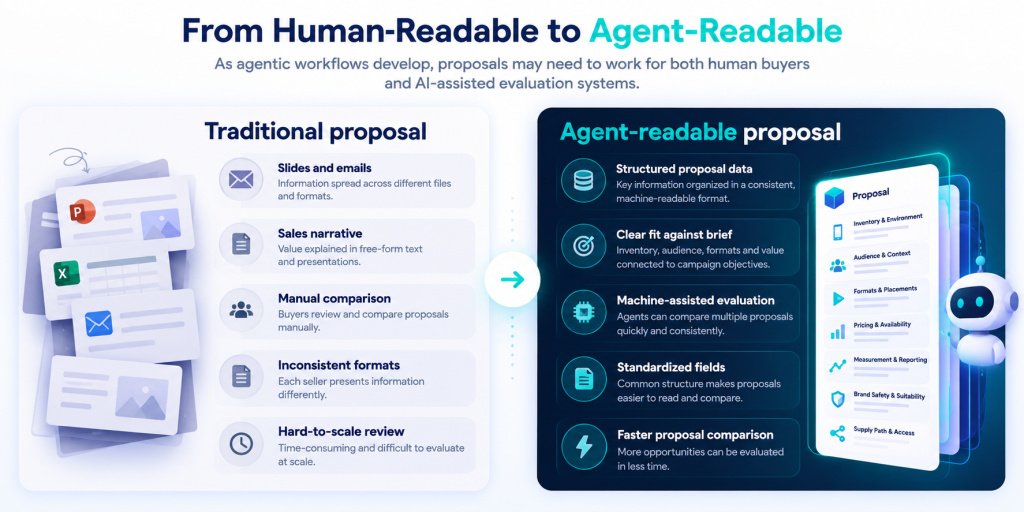
In many cases, that information still lives across decks, spreadsheets, emails, rate cards, and calls. A human planner can piece it together, but the process is inconsistent. Two sellers may offer similar inventory in completely different formats. One proposal may make the value easy to understand. Another may bury the most important details under generic claims or disconnected documents.
This is where agentic buying could change the rhythm of dealmaking.
If buyer agents can help review more opportunities, compare them faster, and flag which proposals fit the brief, the proposal layer becomes more important. It becomes the place where publisher value has to be translated into something structured, comparable, and ready for evaluation.
Why the proposal layer matters
A proposal is more than a sales document. It is where a publisher makes the case for why its inventory fits a buyer’s objective.
Many programmatic deals are not won on scale or price alone. They are won on fit: whether the inventory reaches the right audience, appears in the right environment, supports the right formats, is available at the right time, and can be measured in a way the buyer trusts.
In a manual workflow, those answers can be assembled through conversations and follow-up questions. In an agent-assisted workflow, that inconsistency becomes harder to work around. A buyer agent can only evaluate what it can read. If proposal information is incomplete, unclear, or difficult to compare, even strong inventory may be treated as lower-confidence supply.
That is why the proposal layer matters. It is where publisher value becomes buyer-readable.
From AI decisioning to agent-readable deals
Much of the conversation around agentic AI has focused on decisioning: what agents can do, how much autonomy they should have, how their actions should be governed, and how the industry can keep those decisions transparent and accountable.
That broader shift is already shaping how the market thinks about agentic AI in programmatic advertising. But before an agent can help choose a deal, it needs something clear to evaluate.
That is where readability becomes a commercial issue. A buyer agent cannot judge fit from scattered information, inconsistent formats, or vague claims about premium inventory. It needs structured inputs that connect the buyer’s brief to the seller’s offer.
For publishers, this means inventory quality has to be translated into information that is easy to compare. Context, formats, pricing, availability, measurement, suitability, and supply access all need to be clear enough for both human buyers and AI-assisted systems to understand.
The best proposal may no longer be the one with the most polished deck. It may be the one that makes the strongest fit easiest to recognize.
Why the proposal layer matters
A proposal is more than a sales document. It is where a publisher makes the case for why its inventory fits a buyer’s objective.
Many programmatic deals are not won on scale or price alone. They are won on fit: whether the inventory reaches the right audience, appears in the right environment, supports the right formats, is available at the right time, and can be measured in a way the buyer trusts.
In a manual workflow, those answers can be assembled through conversations and follow-up questions. In an agent-assisted workflow, that inconsistency becomes harder to work around. A buyer agent can only evaluate what it can read. If proposal information is incomplete, unclear, or difficult to compare, even strong inventory may be treated as lower-confidence supply.
That is why the proposal layer matters. It is where publisher value becomes buyer-readable.
From AI decisioning to agent-readable deals
Much of the conversation around agentic AI has focused on decisioning: what agents can do, how much autonomy they should have, how their actions should be governed, and how the industry can keep those decisions transparent and accountable.
That broader shift is already shaping how the market thinks about agentic AI in programmatic advertising. But before an agent can help choose a deal, it needs something clear to evaluate.
That is where readability becomes a commercial issue. A buyer agent cannot judge fit from scattered information, inconsistent formats, or vague claims about premium inventory. It needs structured inputs that connect the buyer’s brief to the seller’s offer.
For publishers, this means inventory quality has to be translated into information that is easy to compare. Context, formats, pricing, availability, measurement, suitability, and supply access all need to be clear enough for both human buyers and AI-assisted systems to understand.
The best proposal may no longer be the one with the most polished deck. It may be the one that makes the strongest fit easiest to recognize.
What OpenProposal is trying to standardize
OpenProposal is part of IAB Tech Lab’s broader AAMP, or Agentic Advertising Management Protocols, initiative. AAMP focuses on bringing agentic AI into the advertising ecosystem through shared infrastructure, protocols, and trust frameworks.
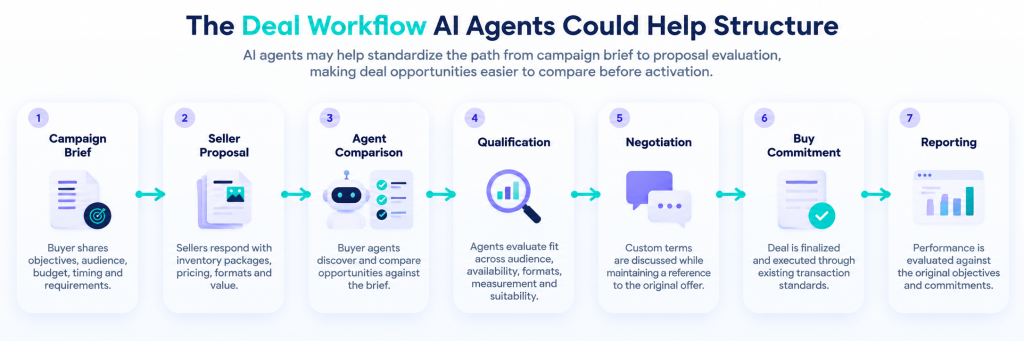
AAMP 3.0 extends that work into the RFP and proposal stage. The goal is to give buyer and seller agents a common way to exchange proposal information, so opportunities can be discovered, compared, qualified, negotiated, committed, and eventually measured against the original plan.
That matters because it connects the earliest part of the campaign lifecycle to the systems that eventually execute the buy. Instead of treating the proposal as a static deck that sits outside the programmatic workflow, OpenProposal points toward a more structured process where the brief, the seller’s offer, the deal terms, and the eventual execution can be more closely aligned.
In practical terms, the workflow could look like this:
| Stage | What changes in an agentic workflow |
| Brief | A buyer’s objective, audience, budget, timing, and requirements are interpreted in a structured way. |
| Proposal | Sellers represent inventory, packages, pricing, formats, and value in a format agents can evaluate. |
| Comparison | Buyer agents can compare opportunities against the brief across more sellers than a human team could manually review. |
| Qualification | Agents can check whether inventory fits the audience, timing, availability, and campaign requirements. |
| Negotiation | Custom terms can be discussed while maintaining a reference to the original offer. |
| Commitment | Once a deal moves forward, existing transaction and execution standards can support activation. |
| Reporting | Performance can be evaluated against the original objectives and commitments. |
The practical value is not just speed. It is consistency. A more structured proposal layer could make it easier for buyers to understand what is being offered and easier for publishers to show why their inventory deserves consideration.
The new risk: invisible premium inventory
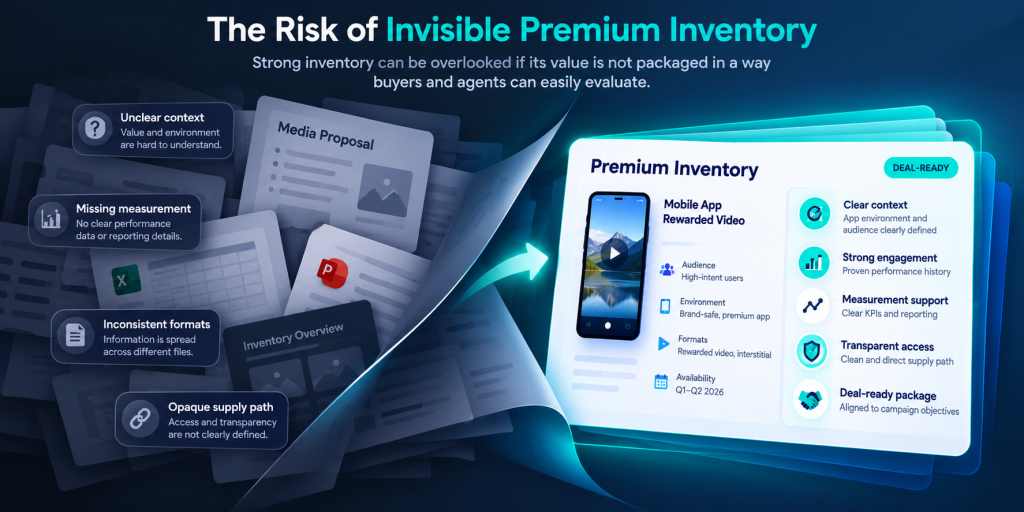
For publishers, the biggest risk is not that AI agents will ignore quality. The bigger risk is that quality may become harder to recognize if it is not represented clearly.
A mobile app publisher may have highly engaged users, strong session depth, rewarded video placements, brand-safe environments, and proven performance. A mobile web publisher may have trusted content, high-intent audiences, strong contextual signals, and valuable page environments.
But if those strengths are not described in a structured way, they may be harder for buyer agents to evaluate.
This creates a new kind of monetization risk: invisible premium inventory. The inventory may be strong, but the proposal may not make that strength easy to read. In a world where agents help buyers compare more opportunities, unclear packaging could become a disadvantage.
That is why proposal readiness should become part of publisher monetization strategy.
What makes a proposal agent-readable
Agentic buying will likely increase the value of clean, structured information. It will not be enough to describe inventory as premium. Buyers and their agents will need to understand why it is valuable, how it fits the brief, and what kind of outcome it can support.
| What needs to be clear | Why it matters |
| Campaign fit | The proposal should connect directly to the buyer’s objective, audience, market, budget, timing, and KPIs. |
| Inventory environment | Mobile app, mobile web, CTV, video, display, native, and in-game environments should be clearly distinguished. |
| Audience and context | Buyers need to understand who the inventory reaches and what content or app environment surrounds the impression. |
| Formats and placements | The proposal should define what is being offered, from rewarded video and interstitials to display, native, or mobile web placements. |
| Pricing and availability | Proposal evaluation depends on clear pricing logic, available volume, timing, and deal terms. |
| Measurement support | Buyers need to know what can be measured, how performance will be evaluated, and what reporting is available. |
| Brand safety and suitability | Agents may need structured signals around category, content, quality controls, and risk. |
| Supply path clarity | Transparent access helps buyers understand where inventory comes from and how it is being reached. |
This is where quality-led supply-path optimization becomes part of the agentic buying conversation. If agents are helping buyers evaluate proposals, clean access paths and reliable supply signals become even more important.
Strong relationships still matter. But they will need stronger data underneath them.
Why this matters for publishers
For publishers, agentic buying could create both opportunity and pressure.
The opportunity is that high-quality inventory may be easier to match with relevant demand when the proposal process becomes more structured. If a publisher has clear contextual signals, strong performance history, transparent access, and well-packaged deals, AI-assisted workflows could help surface that value more efficiently.
The pressure is that messy packaging may become more costly.
If proposal information is incomplete, inconsistent, or hard to compare, buyer agents may treat it as lower-confidence supply. That does not mean the inventory is weak. It means the buying system may not have enough structured evidence to recommend it.
This is where publisher monetization starts to connect with data quality. A strong mobile publisher should not have to compete only on scale or price. But to protect value, it needs to make quality legible: the app environment, mobile web context, user engagement, format, placement, measurement support, and supply path all need to be clear.
For publishers looking to strengthen monetization across mobile app and mobile web environments, this reinforces the need for partners that can connect inventory to quality demand in a transparent and scalable way. AlgoriX’s publisher solutions are built around that connection between supply quality, demand access, and long-term revenue growth.
Why this matters for advertisers
Advertisers also stand to benefit if agentic buying develops in a structured way.
The current proposal process can make comparison difficult. Different sellers may present different levels of detail. Pricing may not be easy to compare. Measurement expectations may not be aligned. Brand safety and suitability claims may not be expressed consistently.
A more standardized proposal layer could help buyers evaluate options faster and with more confidence.
But faster evaluation is only useful if the inputs are reliable. An agent can compare what it can read, but it cannot magically understand value that has not been described properly.
For advertisers, the key question becomes whether buying agents are optimizing for the right signals. If agents compare only price and scale, they may reinforce low-quality buying behavior. If they can evaluate context, quality, suitability, measurement, and supply transparency, they may support smarter decisions.
That is why agentic buying should not be separated from the broader need for transparent, high-quality programmatic supply. For advertisers looking to reach engaged audiences through trusted programmatic access, AlgoriX’s buyer solutions help connect campaign goals with quality inventory across mobile and emerging digital environments.
The value of agentic buying will depend on what the industry teaches agents to care about.
Why this matters for platforms
Platforms and exchanges will play an important role in whether agentic buying becomes useful or just another layer of complexity.
If agents are going to support programmatic deals, the market needs clean infrastructure for proposal data, deal terms, inventory metadata, availability, measurement, and execution.
IAB Tech Lab notes that AAMP connects OpenProposal to standards already used across media execution, including AdCOM, OpenDirect, and the Deals API. Its OpenProposal GitHub repository also provides technical resources for the draft specification.
That continuity matters. Agentic advertising should not create a separate universe with disconnected workflows. It should make existing programmatic processes easier to understand and easier to operate.
For platforms, the opportunity is to help both sides translate commercial goals into structured deal execution. That means supporting better packaging, cleaner metadata, transparent supply paths, and stronger connections between planning, buying, and measurement.
What publishers can prepare now
Publishers do not need to wait for agentic buying to become mainstream before improving how they package inventory.
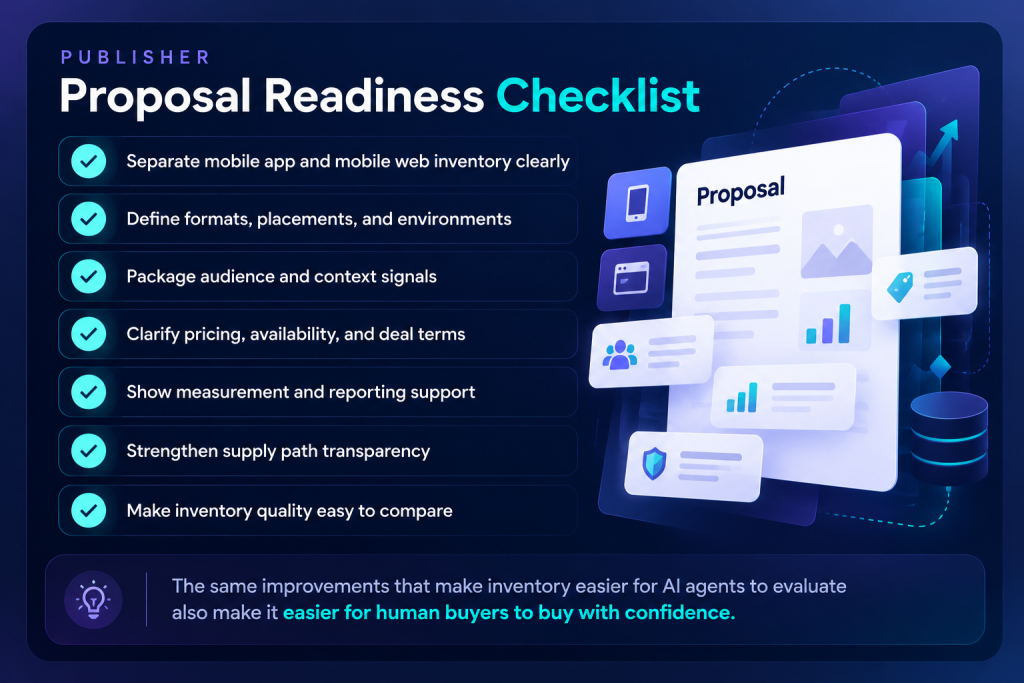
The same steps that make inventory easier for AI agents to evaluate also make it easier for human buyers to understand today.
| Preparation area | What to improve |
| Inventory packaging | Create clearer deal packages around audience, context, format, placement, environment, and objective. |
| Mobile app and web context | Distinguish app inventory from mobile web inventory, and make each environment’s value clear. |
| Metadata quality | Improve the structure and consistency of inventory, format, placement, and content signals. |
| Measurement clarity | Explain what can be measured, what reporting is available, and how success can be evaluated. |
| Supply path transparency | Make access paths clean, direct, and easy for buyers to understand. |
| Commercial differentiation | Move beyond “available impressions” and explain why the inventory is valuable. |
| Deal readiness | Prepare packages that can move quickly from interest to proposal to commitment. |
This is not only preparation for AI. It is better monetization discipline.
The more clearly publishers describe value, the easier it becomes for buyers to justify spend.
The bigger shift: programmatic deals become more structured
The most important effect of agentic buying may not be that AI agents negotiate every deal. It may be that programmatic dealmaking becomes more structured overall.
Campaign briefs may become easier to translate into requirements. Proposals may become easier to compare. Inventory packages may become more standardized. Measurement expectations may become clearer. Deal commitments may move faster.
That could benefit the whole market if it raises the quality of decision-making. But it also means publishers and platforms need to think differently about how value is communicated.
In a more agentic workflow, the best proposal may not be the one with the most polished slide deck. It may be the one with the clearest fit, the strongest signals, the cleanest access, and the most measurable value.
The next programmatic deal playbook
Agentic buying is still developing, and OpenProposal is still in public comment. But the direction is worth watching because it points to a future where the deal process becomes more structured, more machine-readable, and potentially more scalable.
For publishers, the message is simple: quality needs to be easier to evaluate.
For buyers, the opportunity is faster and more consistent proposal comparison, but only if agents are built around meaningful signals.
For platforms, the challenge is to support automation without turning the proposal process into another black box.
Programmatic has already automated the auction. The next shift may be bringing more structure to the path from brief to buy.
The winners will not only be those with inventory. They will be those that can make inventory quality clear enough for both humans and agents to understand.
FAQ
What is agentic buying in advertising?
Agentic buying refers to the use of AI agents to help with parts of the advertising buying process, such as interpreting campaign briefs, evaluating proposals, comparing inventory options, and supporting deal execution.
What is an RFP in advertising?
An RFP, or request for proposal, is a campaign brief that a buyer or agency sends to potential media partners. It usually includes information such as campaign goals, target audience, budget, timing, formats, KPIs, and measurement expectations.
What is OpenProposal?
OpenProposal is an IAB Tech Lab specification introduced as part of AAMP 3.0. It is designed to give buyer and seller AI agents a common way to exchange and evaluate advertising proposal information.
How is this different from broader agentic AI in programmatic advertising?
Broader agentic AI in programmatic advertising covers many possible use cases, including planning, supply evaluation, bidding, optimization, measurement, and reporting. This article focuses specifically on the deal workflow before activation: how campaign briefs become proposals, how proposals are compared, and how inventory becomes easier for buyer agents to evaluate.
Why does agentic buying matter for publishers?
Agentic buying matters because AI-assisted workflows may evaluate inventory based on how clearly it is described. Publishers with strong inventory but poor packaging may be harder for buyer agents to evaluate, while publishers with clear context, quality signals, measurement support, and transparent access may be easier to recommend.
Will AI agents replace human media buyers?
Not necessarily. AI agents are more likely to support buyers by reducing manual work, organizing information, comparing proposals, and flagging options. Human strategy, relationships, judgment, and commercial decision-making will still matter.
How can publishers prepare for agentic buying?
Publishers can prepare by improving inventory packaging, strengthening metadata, making app and mobile web context clearer, improving measurement transparency, creating cleaner supply paths, and building deal packages that are easier to compare and activate.
Why does this matter for programmatic deals?
Programmatic deals depend on trust, clarity, and execution. If AI agents become part of the deal process, the ability to represent inventory in a structured, machine-readable way may become an important part of winning demand.